


- Abuse & The Abuser
- Achievement
- Activity, Fitness & Sport
- Aging & Maturity
- Altruism & Kindness
- Atrocities, Racism & Inequality
- Challenges & Pitfalls
- Choices & Decisions
- Communication Skills
- Crime & Punishment
- Dangerous Situations
- Dealing with Addictions
- Debatable Issues & Moral Questions
- Determination & Achievement
- Diet & Nutrition
- Employment & Career
- Ethical dilemmas
- Experience & Adventure
- Faith, Something to Believe in
- Fears & Phobias
- Friends & Acquaintances
- Habits. Good & Bad
- Honour & Respect
- Human Nature
- Image & Uniqueness
- Immediate Family Relations
- Influence & Negotiation
- Interdependence & Independence
- Life's Big Questions
- Love, Dating & Marriage
- Manners & Etiquette
- Money & Finances
- Moods & Emotions
- Other Beneficial Approaches
- Other Relationships
- Overall health
- Passions & Strengths
- Peace & Forgiveness
- Personal Change
- Personal Development
- Politics & Governance
- Positive & Negative Attitudes
- Rights & Freedom
- Self Harm & Self Sabotage
- Sexual Preferences
- Sexual Relations
- Sins
- Thanks & Gratitude
- The Legacy We Leave
- The Search for Happiness
- Time. Past, present & Future
- Today's World, Projecting Tomorrow
- Truth & Character
- Unattractive Qualities
- Wisdom & Knowledge






FOLLOWERS
Users
Relationships Sundays
Inherent Personality Traits
I've been thinking a lot recently about how much of who we are is how we are born versus how much is a result of our environment, our choices, and our upbringing. We spend so much time as adults trying to “become the best version of ourselves!”, but how much of that is just trying to change who we inherently are?
Take, for example, a child who is naturally high-energy and needs constant stimulation (I have one like that!). We can teach them discipline and focus, but that need for activity and new experiences often remains a big part of who they are throughout their life. Someone else with an inherently cautious or introverted personality can learn to do a job that requires high energy and charisma, but they will likely always crave quiet downtime to recharge.
These inherent personality traits aren't flaws to be fixed; they are the raw material we have to work with. I believe where the conversation needs to go is in learning to recognize what those traits are and then shaping them toward something positive rather than something negative. Because otherwise it can be a dangerous game of simply saying “that’s just the way I’m wired” as an excuse for less-than-desirable behaviour. It's about finding healthy and appropriate outlets for our natural inclinations.
We can't change our nature, but we can absolutely choose our character - that’s about being the best we can be but using our natural traits to inform our choices. Understanding your own inherent personality traits is the first step toward living in a way that feels like it fits for you! You are unique for a reason, so lean into that with good character in mind.

Interesting Fact #1
The Big Five personality traits—openness, conscientiousness, extraversion, agreeableness, and neuroticism—represent broad dimensions of personality that exist on a continuum.
Interesting Fact #2
Both biological and environmental factors influence the development of these traits, and they tend to remain stable over time, though some changes occur with age.
Interesting Fact #3
It is important to note that each of the five primary personality traits represents a range between two extremes. For example, extraversion represents a continuum between extreme extraversion and extreme introversion. In the real world, most people lie somewhere in between.

Quote of the day
“She could be funny, quick-witted, and generous, but she could be volatile too. She could be both fire and ice, and she was street smart.” ― Heather Dark
Article of the day - Personality Traits
Personality traits reflect people’s characteristic patterns of thoughts, feelings, and behaviors. Personality traits imply consistency and stability—someone who scores high on a specific trait like Extraversion is expected to be sociable in different situations and over time. Thus, trait psychology rests on the idea that people differ from one another in terms of where they stand on a set of basic trait dimensions that persist over time and across situations. The most widely used system of traits is called the Five-Factor Model. This system includes five broad traits that can be remembered with the acronym OCEAN: Openness, Conscientiousness, Extraversion, Agreeableness, and Neuroticism. Each of the major traits from the Big Five can be divided into facets to give a more fine-grained analysis of someone's personality. In addition, some trait theorists argue that there are other traits that cannot be completely captured by the Five-Factor Model. Critics of the trait concept argue that people do not act consistently from one situation to the next and that people are very influenced by situational forces. Thus, one major debate in the field concerns the relative power of people’s traits versus the situations in which they find themselves as predictors of their behavior.
Learning Objectives
- List and describe the “Big Five” (“OCEAN”) personality traits that comprise the Five-Factor Model of personality.
- Describe how the facet approach extends broad personality traits.
- Explain a critique of the personality-trait concept.
- Describe in what ways personality traits may be manifested in everyday behavior.
- Describe each of the Big Five personality traits, and the low and high end of the dimension.
- Give examples of each of the Big Five personality traits, including both a low and high example.
- Describe how traits and social learning combine to predict your social activities.
- Describe your theory of how personality traits get refined by social learning.
Introduction
When we observe people around us, one of the first things that strikes us is how different people are from one another. Some people are very talkative while others are very quiet. Some are active whereas others are couch potatoes. Some worry a lot, others almost never seem anxious. Each time we use one of these words, words like “talkative,” “quiet,” “active,” or “anxious,” to describe those around us, we are talking about a person’s personality—the characteristic ways that people differ from one another. Personality psychologists try to describe and understand these differences.

“Are you an introvert”? In popular culture it’s common to talk about people being introverts or extroverts as if these were precise descriptions that meant the same thing for everyone. But research shows that these traits and others are quite variable within individuals. [Image: Nguyen Hung Vu, https://goo.gl/qKJUAC, CC BY 2.0, https://goo.gl/BRvSA7]
Although there are many ways to think about the personalities that people have, Gordon Allport and other “personologists” claimed that we can best understand the differences between individuals by understanding their personality traits. Personality traits reflect basic dimensions on which people differ (Matthews, Deary, & Whiteman, 2003). According to trait psychologists, there are a limited number of these dimensions (dimensions like Extraversion, Conscientiousness, or Agreeableness), and each individual falls somewhere on each dimension, meaning that they could be low, medium, or high on any specific trait.
An important feature of personality traits is that they reflect continuous distributions rather than distinct personality types. This means that when personality psychologists talk about Introverts and Extraverts, they are not really talking about two distinct types of people who are completely and qualitatively different from one another. Instead, they are talking about people who score relatively low or relatively high along a continuous distribution. In fact, when personality psychologists measure traits like Extraversion, they typically find that most people score somewhere in the middle, with smaller numbers showing more extreme levels. The figure below shows the distribution of Extraversion scores from a survey of thousands of people. As you can see, most people report being moderately, but not extremely, extraverted, with fewer people reporting very high or very low scores.
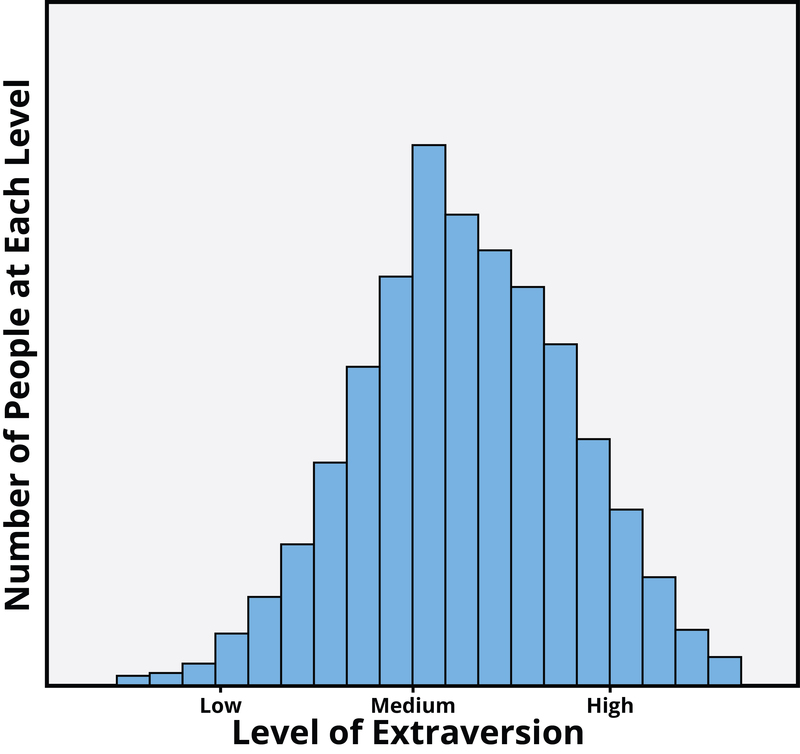
Figure 1. Distribution of Extraversion Scores in a Sample Higher bars mean that more people have scores of that level. This figure shows that most people score towards the middle of the extraversion scale, with fewer people who are highly extraverted or highly introverted.
There are three criteria that are characterize personality traits: (1) consistency, (2) stability, and (3) individual differences.
- To have a personality trait, individuals must be somewhat consistent across situations in their behaviors related to the trait. For example, if they are talkative at home, they tend also to be talkative at work.
- Individuals with a trait are also somewhat stable over time in behaviors related to the trait. If they are talkative, for example, at age 30, they will also tend to be talkative at age 40.
- People differ from one another on behaviors related to the trait. Using speech is not a personality trait and neither is walking on two feet—virtually all individuals do these activities, and there are almost no individual differences. But people differ on how frequently they talk and how active they are, and thus personality traits such as Talkativeness and Activity Level do exist.
A challenge of the trait approach was to discover the major traits on which all people differ. Scientists for many decades generated hundreds of new traits, so that it was soon difficult to keep track and make sense of them. For instance, one psychologist might focus on individual differences in “friendliness,” whereas another might focus on the highly related concept of “sociability.” Scientists began seeking ways to reduce the number of traits in some systematic way and to discover the basic traits that describe most of the differences between people.
The way that Gordon Allport and his colleague Henry Odbert approached this was to search the dictionary for all descriptors of personality (Allport & Odbert, 1936). Their approach was guided by the lexical hypothesis, which states that all important personality characteristics should be reflected in the language that we use to describe other people. Therefore, if we want to understand the fundamental ways in which people differ from one another, we can turn to the words that people use to describe one another. So if we want to know what words people use to describe one another, where should we look? Allport and Odbert looked in the most obvious place—the dictionary. Specifically, they took all the personality descriptors that they could find in the dictionary (they started with almost 18,000 words but quickly reduced that list to a more manageable number) and then used statistical techniques to determine which words “went together.” In other words, if everyone who said that they were “friendly” also said that they were “sociable,” then this might mean that personality psychologists would only need a single trait to capture individual differences in these characteristics. Statistical techniques were used to determine whether a small number of dimensions might underlie all of the thousands of words we use to describe people.
The Five-Factor Model of Personality
Research that used the lexical approach showed that many of the personality descriptors found in the dictionary do indeed overlap. In other words, many of the words that we use to describe people are synonyms. Thus, if we want to know what a person is like, we do not necessarily need to ask how sociable they are, how friendly they are, and how gregarious they are. Instead, because sociable people tend to be friendly and gregarious, we can summarize this personality dimension with a single term. Someone who is sociable, friendly, and gregarious would typically be described as an “Extravert.” Once we know she is an extravert, we can assume that she is sociable, friendly, and gregarious.
Statistical methods (specifically, a technique called factor analysis) helped to determine whether a small number of dimensions underlie the diversity of words that people like Allport and Odbert identified. The most widely accepted system to emerge from this approach was “The Big Five” or “Five-Factor Model” (Goldberg, 1990; McCrae & John, 1992; McCrae & Costa, 1987). The Big Five comprises five major traits shown in the Figure 2 below. A way to remember these five is with the acronym OCEAN (O is for Openness; C is for Conscientiousness; E is for Extraversion; A is for Agreeableness; N is for Neuroticism). Figure 3 provides descriptions of people who would score high and low on each of these traits.
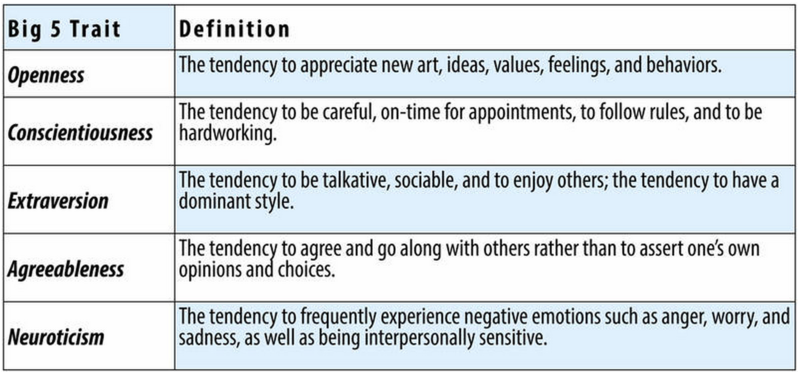
Figure 2. Descriptions of the Big Five Personality Traits
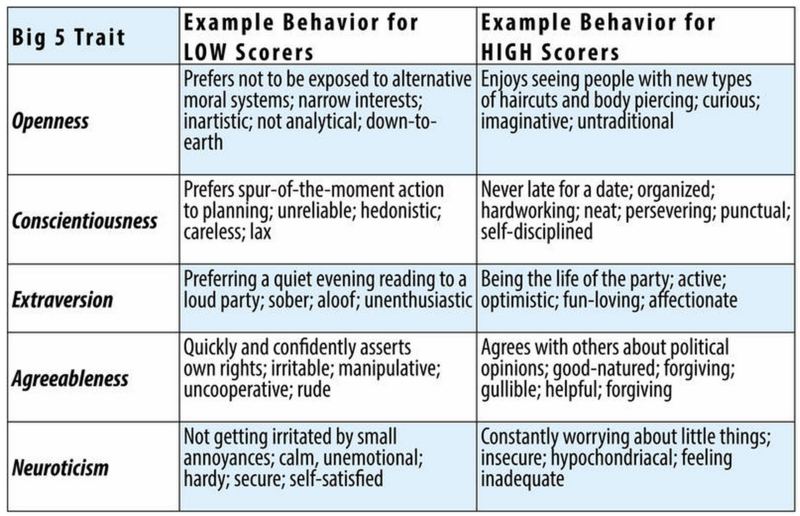
Figure 3. Example behaviors for those scoring low and high for the big 5 traits
Scores on the Big Five traits are mostly independent. That means that a person’s standing on one trait tells very little about their standing on the other traits of the Big Five. For example, a person can be extremely high in Extraversion and be either high or low on Neuroticism. Similarly, a person can be low in Agreeableness and be either high or low in Conscientiousness. Thus, in the Five-Factor Model, you need five scores to describe most of an individual’s personality.
In the Appendix to this module, we present a short scale to assess the Five-Factor Model of personality (Donnellan, Oswald, Baird, & Lucas, 2006). You can take this test to see where you stand in terms of your Big Five scores. John Johnson has also created a helpful website that has personality scales that can be used and taken by the general public:
http://www.personal.psu.edu/j5j/IPIP/ipipneo120.htm
After seeing your scores, you can judge for yourself whether you think such tests are valid.
Traits are important and interesting because they describe stable patterns of behavior that persist for long periods of time (Caspi, Roberts, & Shiner, 2005). Importantly, these stable patterns can have broad-ranging consequences for many areas of our life (Roberts, Kuncel, Shiner, Caspi, & Goldberg, 2007). For instance, think about the factors that determine success in college. If you were asked to guess what factors predict good grades in college, you might guess something like intelligence. This guess would be correct, but we know much more about who is likely to do well. Specifically, personality researchers have also found the personality traits like Conscientiousness play an important role in college and beyond, probably because highly conscientious individuals study hard, get their work done on time, and are less distracted by nonessential activities that take time away from school work. In addition, highly conscientious people are often healthier than people low in conscientiousness because they are more likely to maintain healthy diets, to exercise, and to follow basic safety procedures like wearing seat belts or bicycle helmets. Over the long term, this consistent pattern of behaviors can add up to meaningful differences in health and longevity. Thus, personality traits are not just a useful way to describe people you know; they actually help psychologists predict how good a worker someone will be, how long he or she will live, and the types of jobs and activities the person will enjoy. Thus, there is growing interest in personality psychology among psychologists who work in applied settings, such as health psychology or organizational psychology.
Facets of Traits (Subtraits)
So how does it feel to be told that your entire personality can be summarized with scores on just five personality traits? Do you think these five scores capture the complexity of your own and others’ characteristic patterns of thoughts, feelings, and behaviors? Most people would probably say no, pointing to some exception in their behavior that goes against the general pattern that others might see. For instance, you may know people who are warm and friendly and find it easy to talk with strangers at a party yet are terrified if they have to perform in front of others or speak to large groups of people. The fact that there are different ways of being extraverted or conscientious shows that there is value in considering lower-level units of personality that are more specific than the Big Five traits. These more specific, lower-level units of personality are often called facets.
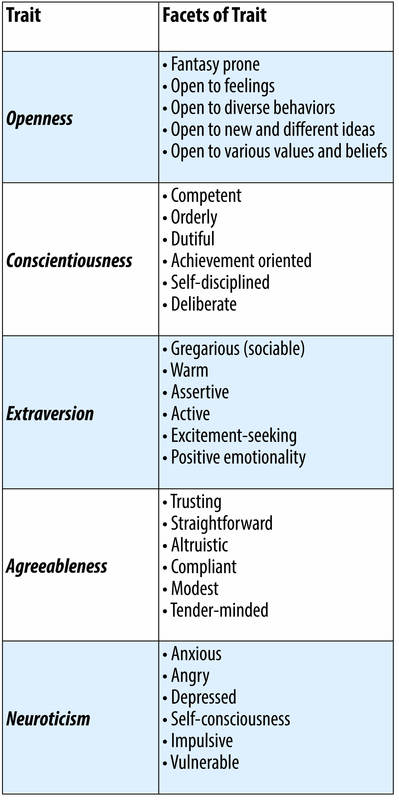
Figure 4. Facets of Traits
To give you a sense of what these narrow units are like, Figure 4 shows facets for each of the Big Five traits. It is important to note that although personality researchers generally agree about the value of the Big Five traits as a way to summarize one’s personality, there is no widely accepted list of facets that should be studied. The list seen here, based on work by researchers Paul Costa and Jeff McCrae, thus reflects just one possible list among many. It should, however, give you an idea of some of the facets making up each of the Five-Factor Model.
Facets can be useful because they provide more specific descriptions of what a person is like. For instance, if we take our friend who loves parties but hates public speaking, we might say that this person scores high on the “gregariousness” and “warmth” facets of extraversion, while scoring lower on facets such as “assertiveness” or “excitement-seeking.” This precise profile of facet scores not only provides a better description, it might also allow us to better predict how this friend will do in a variety of different jobs (for example, jobs that require public speaking versus jobs that involve one-on-one interactions with customers; Paunonen & Ashton, 2001). Because different facets within a broad, global trait like extraversion tend to go together (those who are gregarious are often but not always assertive), the broad trait often provides a useful summary of what a person is like. But when we really want to know a person, facet scores add to our knowledge in important ways.
Other Traits Beyond the Five-Factor Model
Despite the popularity of the Five-Factor Model, it is certainly not the only model that exists. Some suggest that there are more than five major traits, or perhaps even fewer. For example, in one of the first comprehensive models to be proposed, Hans Eysenck suggested that Extraversion and Neuroticism are most important. Eysenck believed that by combining people’s standing on these two major traits, we could account for many of the differences in personality that we see in people (Eysenck, 1981). So for instance, a neurotic introvert would be shy and nervous, while a stable introvert might avoid social situations and prefer solitary activities, but he may do so with a calm, steady attitude and little anxiety or emotion. Interestingly, Eysenck attempted to link these two major dimensions to underlying differences in people’s biology. For instance, he suggested that introverts experienced too much sensory stimulation and arousal, which made them want to seek out quiet settings and less stimulating environments. More recently, Jeffrey Gray suggested that these two broad traits are related to fundamental reward and avoidance systems in the brain—extraverts might be motivated to seek reward and thus exhibit assertive, reward-seeking behavior, whereas people high in neuroticism might be motivated to avoid punishment and thus may experience anxiety as a result of their heightened awareness of the threats in the world around them (Gray, 1981. This model has since been updated; see Gray & McNaughton, 2000). These early theories have led to a burgeoning interest in identifying the physiological underpinnings of the individual differences that we observe.
Another revision of the Big Five is the HEXACO model of traits (Ashton & Lee, 2007). This model is similar to the Big Five, but it posits slightly different versions of some of the traits, and its proponents argue that one important class of individual differences was omitted from the Five-Factor Model. The HEXACO adds Honesty-Humility as a sixth dimension of personality. People high in this trait are sincere, fair, and modest, whereas those low in the trait are manipulative, narcissistic, and self-centered. Thus, trait theorists are agreed that personality traits are important in understanding behavior, but there are still debates on the exact number and composition of the traits that are most important.
There are other important traits that are not included in comprehensive models like the Big Five. Although the five factors capture much that is important about personality, researchers have suggested other traits that capture interesting aspects of our behavior. In Figure 5 below we present just a few, out of hundreds, of the other traits that have been studied by personologists.
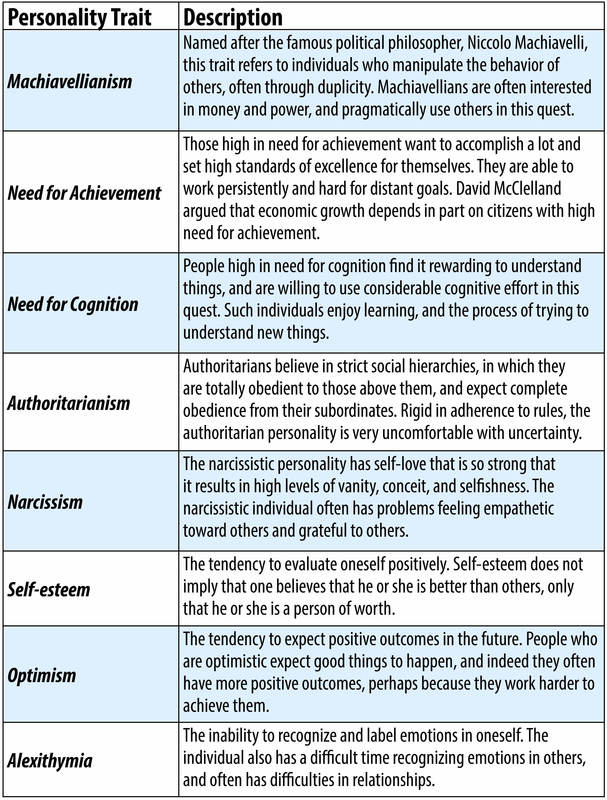
Figure 5. Other Traits Beyond Those Included in the Big Five
Not all of the above traits are currently popular with scientists, yet each of them has experienced popularity in the past. Although the Five-Factor Model has been the target of more rigorous research than some of the traits above, these additional personality characteristics give a good idea of the wide range of behaviors and attitudes that traits can cover.
The Person-Situation Debate and Alternatives to the Trait Perspective

The way people behave is only in part a product of their natural personality. Situations also influence how a person behaves. Are you for instance a “different person” as a student in a classroom compared to when you’re a member of a close-knit social group? [Image: UO Education, https://goo.gl/ylgV9T, CC BY-NC 2.0, https://goo.gl/VnKlK8]
The ideas described in this module should probably seem familiar, if not obvious to you. When asked to think about what our friends, enemies, family members, and colleagues are like, some of the first things that come to mind are their personality characteristics. We might think about how warm and helpful our first teacher was, how irresponsible and careless our brother is, or how demanding and insulting our first boss was. Each of these descriptors reflects a personality trait, and most of us generally think that the descriptions that we use for individuals accurately reflect their “characteristic pattern of thoughts, feelings, and behaviors,” or in other words, their personality.
But what if this idea were wrong? What if our belief in personality traits were an illusion and people are not consistent from one situation to the next? This was a possibility that shook the foundation of personality psychology in the late 1960s when Walter Mischel published a book called Personality and Assessment (1968). In this book, Mischel suggested that if one looks closely at people’s behavior across many different situations, the consistency is really not that impressive. In other words, children who cheat on tests at school may steadfastly follow all rules when playing games and may never tell a lie to their parents. In other words, he suggested, there may not be any general trait of honesty that links these seemingly related behaviors. Furthermore, Mischel suggested that observers may believe that broad personality traits like honesty exist, when in fact, this belief is an illusion. The debate that followed the publication of Mischel’s book was called the person-situation debate because it pitted the power of personality against the power of situational factors as determinants of the behavior that people exhibit.
Because of the findings that Mischel emphasized, many psychologists focused on an alternative to the trait perspective. Instead of studying broad, context-free descriptions, like the trait terms we’ve described so far, Mischel thought that psychologists should focus on people’s distinctive reactions to specific situations. For instance, although there may not be a broad and general trait of honesty, some children may be especially likely to cheat on a test when the risk of being caught is low and the rewards for cheating are high. Others might be motivated by the sense of risk involved in cheating and may do so even when the rewards are not very high. Thus, the behavior itself results from the child’s unique evaluation of the risks and rewards present at that moment, along with her evaluation of her abilities and values. Because of this, the same child might act very differently in different situations. Thus, Mischel thought that specific behaviors were driven by the interaction between very specific, psychologically meaningful features of the situation in which people found themselves, the person’s unique way of perceiving that situation, and his or her abilities for dealing with it. Mischel and others argued that it was these social-cognitive processes that underlie people’s reactions to specific situations that provide some consistency when situational features are the same. If so, then studying these broad traits might be more fruitful than cataloging and measuring narrow, context-free traits like Extraversion or Neuroticism.
In the years after the publication of Mischel’s (1968) book, debates raged about whether personality truly exists, and if so, how it should be studied. And, as is often the case, it turns out that a more moderate middle ground than what the situationists proposed could be reached. It is certainly true, as Mischel pointed out, that a person’s behavior in one specific situation is not a good guide to how that person will behave in a very different specific situation. Someone who is extremely talkative at one specific party may sometimes be reticent to speak up during class and may even act like a wallflower at a different party. But this does not mean that personality does not exist, nor does it mean that people’s behavior is completely determined by situational factors. Indeed, research conducted after the person-situation debate shows that on average, the effect of the “situation” is about as large as that of personality traits. However, it is also true that if psychologists assess a broad range of behaviors across many different situations, there are general tendencies that emerge. Personality traits give an indication about how people will act on average, but frequently they are not so good at predicting how a person will act in a specific situation at a certain moment in time. Thus, to best capture broad traits, one must assess aggregate behaviors, averaged over time and across many different types of situations. Most modern personality researchers agree that there is a place for broad personality traits and for the narrower units such as those studied by Walter Mischel.
Appendix
The Mini-IPIP Scale
(Donnellan, Oswald, Baird, & Lucas, 2006)
Instructions: Below are phrases describing people’s behaviors. Please use the rating scale below to describe how accurately each statement describes you. Describe yourself as you generally are now, not as you wish to be in the future. Describe yourself as you honestly see yourself, in relation to other people you know of the same sex as you are, and roughly your same age. Please read each statement carefully, and put a number from 1 to 5 next to it to describe how accurately the statement describes you.
1 = Very inaccurate
2 = Moderately inaccurate
3 = Neither inaccurate nor accurate
4 = Moderately accurate
5 = Very accurate
- _______ Am the life of the party (E)
- _______ Sympathize with others’ feelings (A)
- _______ Get chores done right away (C)
- _______ Have frequent mood swings (N)
- _______ Have a vivid imagination (O)
- _______Don’t talk a lot (E)
- _______ Am not interested in other people’s problems (A)
- _______ Often forget to put things back in their proper place (C)
- _______ Am relaxed most of the time (N)
- ______ Am not interested in abstract ideas (O)
- ______ Talk to a lot of different people at parties (E)
- ______ Feel others’ emotions (A)
- ______ Like order (C)
- ______ Get upset easily (N)
- ______ Have difficulty understanding abstract ideas (O)
- ______ Keep in the background (E)
- ______ Am not really interested in others (A)
- ______ Make a mess of things (C)
- ______ Seldom feel blue (N)
- ______ Do not have a good imagination (O)
Scoring: The first thing you must do is to reverse the items that are worded in the opposite direction. In order to do this, subtract the number you put for that item from 6. So if you put a 4, for instance, it will become a 2. Cross out the score you put when you took the scale, and put the new number in representing your score subtracted from the number 6.
Items to be reversed in this way: 6, 7, 8, 9, 10, 15, 16, 17, 18, 19, 20
Next, you need to add up the scores for each of the five OCEAN scales (including the reversed numbers where relevant). Each OCEAN score will be the sum of four items. Place the sum next to each scale below.
__________ Openness: Add items 5, 10, 15, 20
__________ Conscientiousness: Add items 3, 8, 13, 18
__________ Extraversion: Add items 1, 6, 11, 16
__________ Agreeableness: Add items 2, 7, 12, 17
__________ Neuroticism: Add items 4, 9,14, 19
Compare your scores to the norms below to see where you stand on each scale. If you are low on a trait, it means you are the opposite of the trait label. For example, low on Extraversion is Introversion, low on Openness is Conventional, and low on Agreeableness is Assertive.
19–20 Extremely High, 17–18 Very High, 14–16 High,
11–13 Neither high nor low; in the middle, 8–10 Low, 6–7 Very low, 4–5 Extremely low
Question of the day - What is one personality trait you recognized in yourself early in life that you have successfully learned to manage or channel in a positive way?
Truth & Character
What is one personality trait you recognized in yourself early in life that you have successfully learned to manage or channel in a positive way?
Subscribe to our newsletter
Daily archives
Current Survey
Top 5 Contributors (Apr)

20209 pts

12060 pts

10714 pts

10417 pts

10117 pts